CULTURE INCORPORATED
CONVERSATION Frameworks
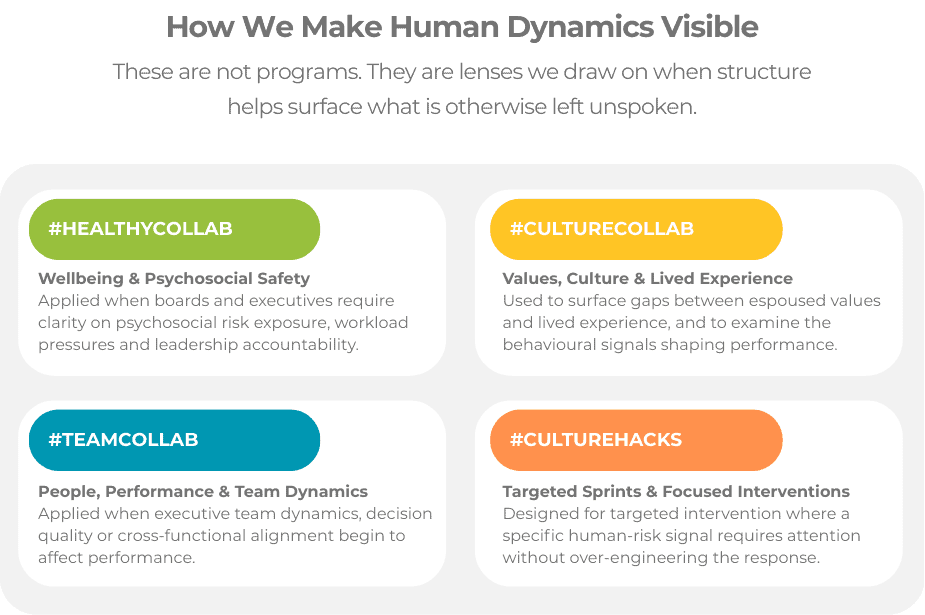
Making Human Dynamics Visible
JUDGEMENT FIRST. TOOLS SECOND
These frameworks support facilitation, team dialogue and structured reflection.
They are used selectively where they add clarity or shared language – and sit alongside our core governance lenses.
01
#HEALTHYCollab™
02
#CULTURECollab™
03
#TEAMCollab™
04
#CULTUREHACKS™
01
#HEALTHYCollab™
Wellbeing & Psychosocial Safety
Psychosocial risk is not just a compliance obligation. It is a signal of how work is designed, how leadership is exercised and how pressure is managed.
#HEALTHYCollab™ provides structured clarity across the recognised psychosocial risk factors shaping mental health and performance. It enables boards and executive teams to identify exposure, understand root causes and align leadership accountability.
This is preventative work. Not reactive.
High job demands, low control, poor support or unclear expectations rarely exist in isolation. They indicate deeper design and behavioural patterns.
Addressing them early reduces risk, strengthens performance and builds cultures where sustainable pressure – not silent strain – becomes the norm.
WHAT ARE PSYCHOSOCIAL FACTORS?
02
#CULTURECollab™
Values, Culture & Lived Experience
Culture is not what is written. It is what is tolerated, rewarded and repeated.
#CULTURECollab™ makes culture tangible by mapping the gap between espoused intent and lived experience. It surfaces the behavioural signals shaping performance and highlights where confidence may be thinning beneath stable metrics.
This framework enables leaders to:
- Clarify the cultural patterns driving behaviour
- Identify misalignment between strategy and everyday practice
- Prioritise targeted shifts rather than broad initiatives
- Establish shared language around expectations and accountability
Culture does not drift loudly. It drifts quietly. This work makes that drift visible before it hardens.
03
#TEAMCOLLAB™
People, Performance & Team Dynamics
Performance risk often sits inside the executive team.
#TEAMCollab™ focuses on the behavioural and relational dynamics shaping decision quality, alignment and accountability.
It is grounded in behavioural science and people analytics, not personality entertainment.
This work examines:
- How power is exercised and challenged
- How dissent is handled
- How decisions are made under pressure
- Where friction signals deeper structural issues
When executive dynamics shift, performance shifts.
This is not development theatre. It is performance infrastructure.
04
#CULTUREHACKS
Targeted Sprints & Focused Interventions
Not every signal requires a full program.
#CULTUREHacks™ are structured, targeted interventions designed to address defined human-risk signals without over-engineering the response.
They are used when a specific issue needs focused attention – for example:
-
Psychological safety in a high-stakes project
-
Alignment after strategic change
-
Clarifying behavioural expectations
-
Resetting leadership tone under pressure
These are deliberate, contained shifts – designed to stabilise, realign or unlock momentum where it matters most.
CURIOUS
ABOUT WHAT THIS MIGHT MEAN FOR YOUR ORGANISATION?
If the themes on this site reflect conversations already happening in your boardroom, a considered discussion is often the right next step.